
Airport Terminal & Aviation Facility Roofing in Detroit, MI
Airport Terminal and Aviation Facility Roofing in Detroit, MI
An airport never stops, and its roofs cannot pretend otherwise. A terminal handles passengers at three in the morning, cargo moves through the night, and aircraft are running on the apron a few hundred feet from where a crew would stage material. That single fact reshapes everything: every access point, every crane lift, and every crew deployment has to be cleared through the airport's facilities department and its FAA Part 139 safety program, and on secure areas through TSA protocols as well. We treat aviation roofing in Detroit as a coordination project first and a roofing project second, and we build that coordination into the scope before the contract is signed rather than discovering it after mobilization.
The anchor of this market is Detroit Metropolitan Wayne County Airport (DTW) out in Romulus — one of the country's busier hubs and Delta's principal Midwest connecting point, with the McNamara Terminal and the North Terminal complex, plus a constant pipeline of concourse and facility upgrades. Around it sits a dense ring of aviation-adjacent buildings: air-cargo facilities, rental-car centers, FBO hangars, aircraft-maintenance buildings, and the hotels on the airport campus. Detroit also keeps two general-aviation airports in play — Coleman A. Young Municipal Airport (DET) on the city's east side and Willow Run Airport (YIP) in Ypsilanti, a major freight and general-aviation field. Each building type is a different roof, but the airport-coordination requirement never goes away.
Why a Terminal Roof Is Not Just a Big Commercial Roof
Terminal roofs are large, flat expanses with very little slope, which puts drainage design front and center and leaves almost no tolerance for ponding — water that would be a nuisance on a store roof is a structural and membrane problem across acres of terminal deck. The mechanical load is heavier and denser than standard commercial, with a high count of curbed HVAC penetrations feeding the air handling a busy terminal requires, and each oversized curb and complex through-penetration needs an individually engineered flashing rather than a stock detail. On airside roofs there is jet blast to contend with: membrane adhesion and any ballast have to be specified well beyond what a comparable logistics building would call for, because a sudden blast of thrust will find an under-attached edge. We bring those lessons in with us; we do not learn them on your project.
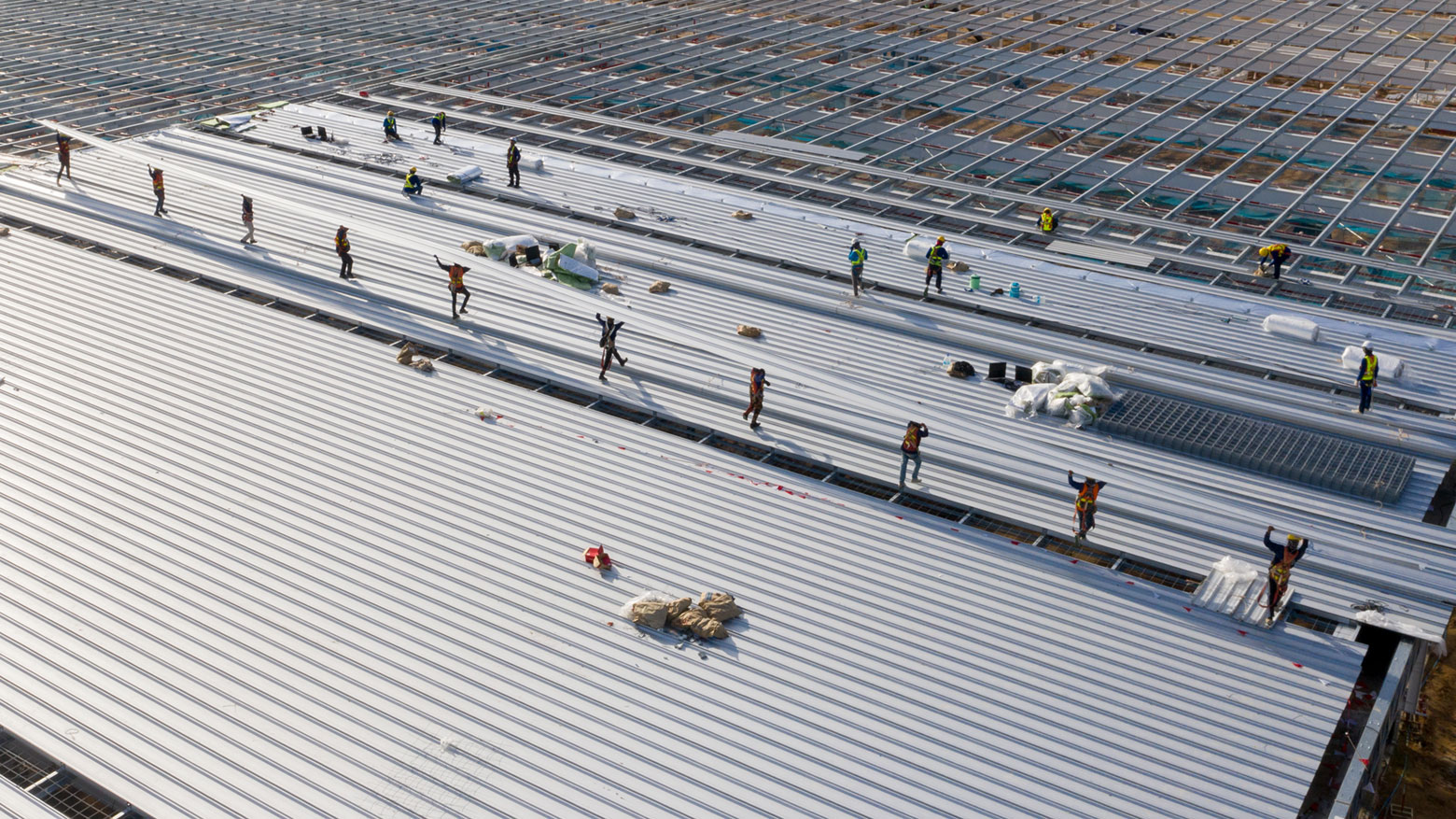
FBO hangars and general-aviation buildings flip the equation. The security protocols are lighter, but the structures are more demanding — high-bay clear-span buildings, often pre-engineered metal systems, whose wide roofs generate large wind-uplift loads and significant thermal movement. These need specific fastening patterns and seam geometry, and on new high-bay work a standing-seam metal roof is frequently the right answer. We specify and install both single-ply and metal systems on these buildings across Metro Detroit.
Cargo facilities, rental-car centers, maintenance shops, and campus hotels each carry their own roof challenges, but if any part of the work touches airport property, badging and security access are non-negotiable. Our crews plan for credentialing as a baseline, not something to sort out onsite the first morning.
Air-cargo buildings deserve a particular mention, because freight is a major part of what moves through the Detroit region. These are large low-slope roofs over operations that load and unload around the clock, with truck docks on one side and apron access on the other, and forklift and conveyor activity that never fully pauses. The roof over a sort facility takes heavy rooftop mechanical loads and a steady stream of foot traffic from crews servicing that equipment, so walkway pads, reinforced membrane at high-traffic zones, and a drainage layout that clears water fast all matter more than they would on a quiet warehouse. We sequence cargo-roof work around shipping cycles the same way we sequence terminal work around passenger flow — the freight does not stop because the roof needs attention, so the plan accommodates the operation rather than fighting it.
Scheduling Inside an Operating Airport
We work with the airport facilities department and the Part 139 coordinator to build a phased plan that airport operations approves before anything moves. Material deliveries, crane and hoist lifts, and any work near airside areas run only in approved windows, coordinated with the FAA NOTAM process where required. Crew members are not mobilized to airside areas without confirmed authorization — that is a baseline we enforce, not a favor we ask. The result is a project that keeps the terminal, the cargo dock, and the apron running while the roof gets replaced over them.
How do you schedule work at an operating airport like DTW?
We develop a phased plan with the airport facilities department and the FAA Part 139 coordinator and get it approved by airport operations before work begins. Deliveries, crane lifts, and airside work run only in approved windows, coordinated through the NOTAM process where required.
What roof systems do you use on large terminal roofs?
Most terminal re-roofing uses TPO or PVC single-ply over a tapered insulation system that improves drainage and addresses ponding. We finalize the spec after walking the roof with your facilities engineer and confirming deck type and load capacity.
How do you deal with the heavy HVAC density on a terminal?
Our pre-project survey documents every penetration, curb height, and clearance before we plan the work. Oversized curbs and complex through-penetrations are flashed with individually engineered details, not stock patterns.
Can you work on airside structures near active runways and gates?
Yes, with proper badging and full coordination with airfield operations. Airside work requires extra pre-planning and crew credentialing, which we build into the bid timeline. We do not mobilize crew without confirmed airside authorization.
Do you handle hangar roofing for FBOs and general aviation?
Yes. High-bay hangars on wide-flange steel or pre-engineered systems are a regular part of our work. We specify the fastening and seam geometry for those structures' uplift and thermal-movement characteristics, and install metal or single-ply as the building calls for.
Roof-area photos, access notes, leak points, rooftop equipment conditions, and visible membrane details.
Drainage, seams, curbs, penetrations, edge metal, winter exposure, repair limits, and replacement triggers.
A practical split between emergency work, repair, maintenance, coating, recover, and replacement planning.