Hail Damage Roof Insurance Claims in Detroit, MI
Southeast Michigan gets real hail most years, usually riding along the same spring and summer thunderstorm lines that bring heavy rain and wind to the region. On a flat or low-slope commercial roof, hail does not leave the obvious cracked-shingle pattern people picture from residential claims. It bruises membrane, dents edge metal, and knocks granules loose in a way that a ground-level look, or even a drive-by photo, will usually miss. We're your roofing contractor, not a public adjuster — we document and substantiate the roof damage so you and your adjuster work from an accurate scope.
What hail impact actually looks like on a low-slope roof
On EPDM and TPO membranes, hail impact shows up as circular bruising or soft depressions that can be difficult to see without close inspection and the right lighting angle. On aging built-up and modified bitumen roofs — common across Detroit's manufacturing corridor and older downtown buildings — hail knocks granules off the cap sheet and can expose the felt underneath, accelerating UV wear even where there is no immediate leak. Metal components take the most visible hits: dented coping, edge metal, roof curbs, and any exposed HVAC housing usually show impact marks that establish the storm actually reached that roof.
Documenting impact evidence the right way
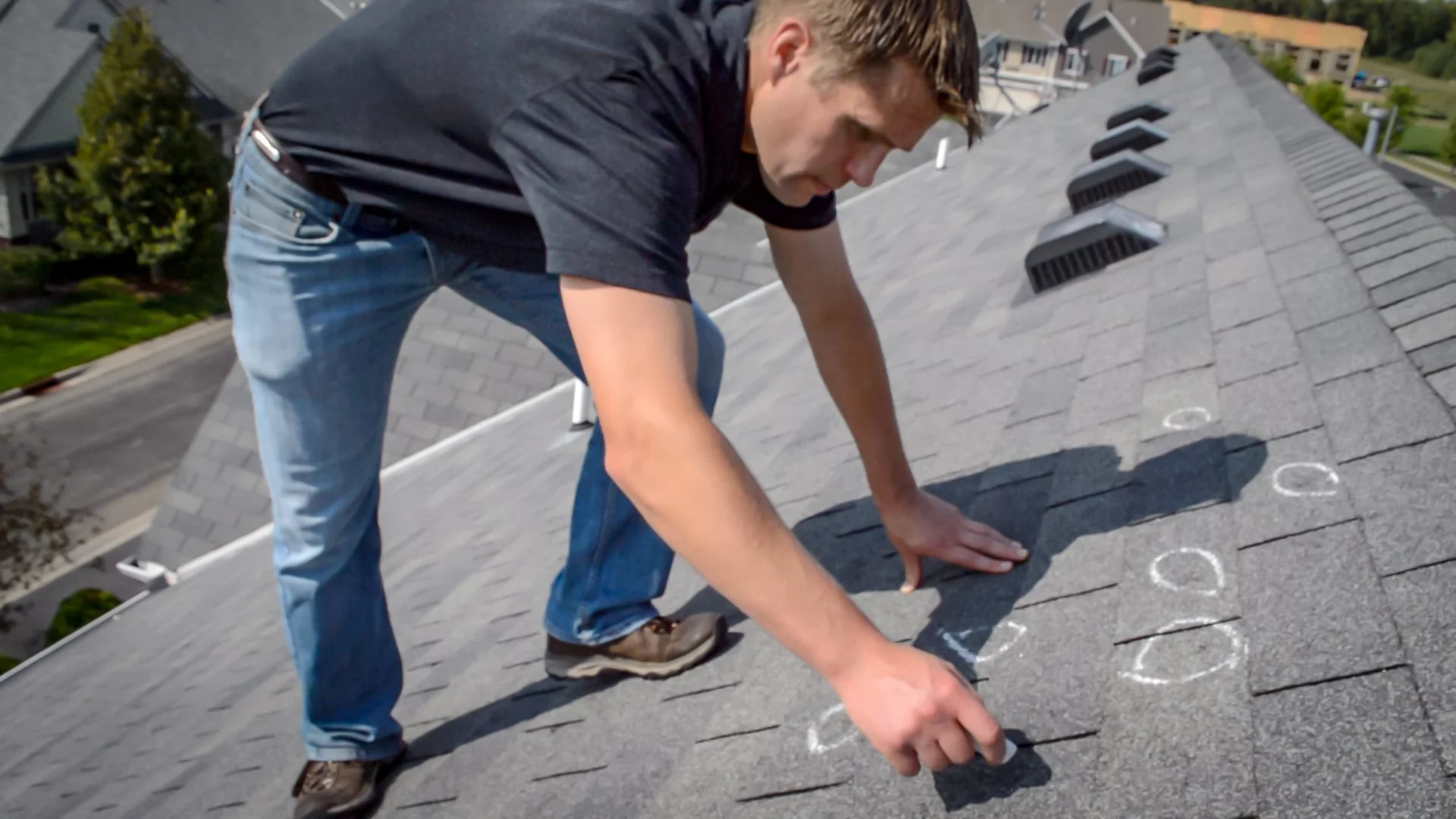
We inspect the roof in a grid pattern, not a spot check, because hail rarely damages a roof evenly. We photograph impact marks at a scale that shows their size and spacing, count and map impact density across representative test squares, and check drains and low points for granule accumulation that confirms cap-sheet erosion. Where impact marks are subtle on a membrane roof, we use a probe or a small core sample at a suspected point to confirm whether the membrane has lost thickness, which is the detail that separates cosmetic marking from functional damage.
Meeting the adjuster on a hail claim
Hail claims are argued more than most, because the damage is real but not always dramatic-looking in a single photo. We walk the roof with the adjuster and point out impact patterns, test-square counts, and any confirmed membrane thinning directly on the roof surface, rather than relying on a report alone to make the case. On occupied buildings we schedule that walk around tenant hours and roof access limits so it does not become another delay in an already slow claim process.
Framing the full hail scope
A hail event affects the whole exposed roof surface, not only the section nearest a reported leak, so our inspection covers the entire field, all edge metal, and every rooftop unit and curb. The report separates confirmed functional damage — membrane thinning, split laps, dented drains — from cosmetic-only marking, and covers metal component replacement where dents affect drainage or weathertightness. That full accounting matters because partial hail repairs on an otherwise intact roof rarely match in appearance or performance, and a scope that misses damaged sections leaves the owner covering the gap later.
Frequently asked questions
Does hail actually damage a flat commercial roof? Yes, though it looks different than shingle damage. Hail bruises single-ply membranes, dents metal edge and coping, and knocks granules off built-up and modified bitumen cap sheets, all of which can be hard to see from the ground.
How soon after a hailstorm should the roof be inspected? As soon as it is safe to access the roof. Bruised membrane and dented metal do not always leak right away, so early documentation preserves evidence before weather or roof traffic obscures it.
Can hail damage be confirmed without cutting into the membrane? Most hail impact points can be identified and photographed on the surface. In some cases a small probe or core sample is used to confirm membrane thickness loss at a suspected impact site.
What if the adjuster says the roof damage is cosmetic? We document impact density, membrane thinning, and any confirmed water intrusion so the report distinguishes cosmetic marking from damage that affects the roof's function and remaining service life.
Will you maximize our payout? No. We document the complete, accurate scope of hail damage — everything the storm actually affected — so nothing legitimate gets missed. We do not represent the claim to the insurer or promise a specific payout.
Grid-pattern impact photos, test-square counts, and probe or core confirmation of membrane thinning.
Full roof field, edge metal, and rooftop equipment reviewed, with cosmetic marking separated from functional damage.
A report built to hold up when a hail claim gets a second look.